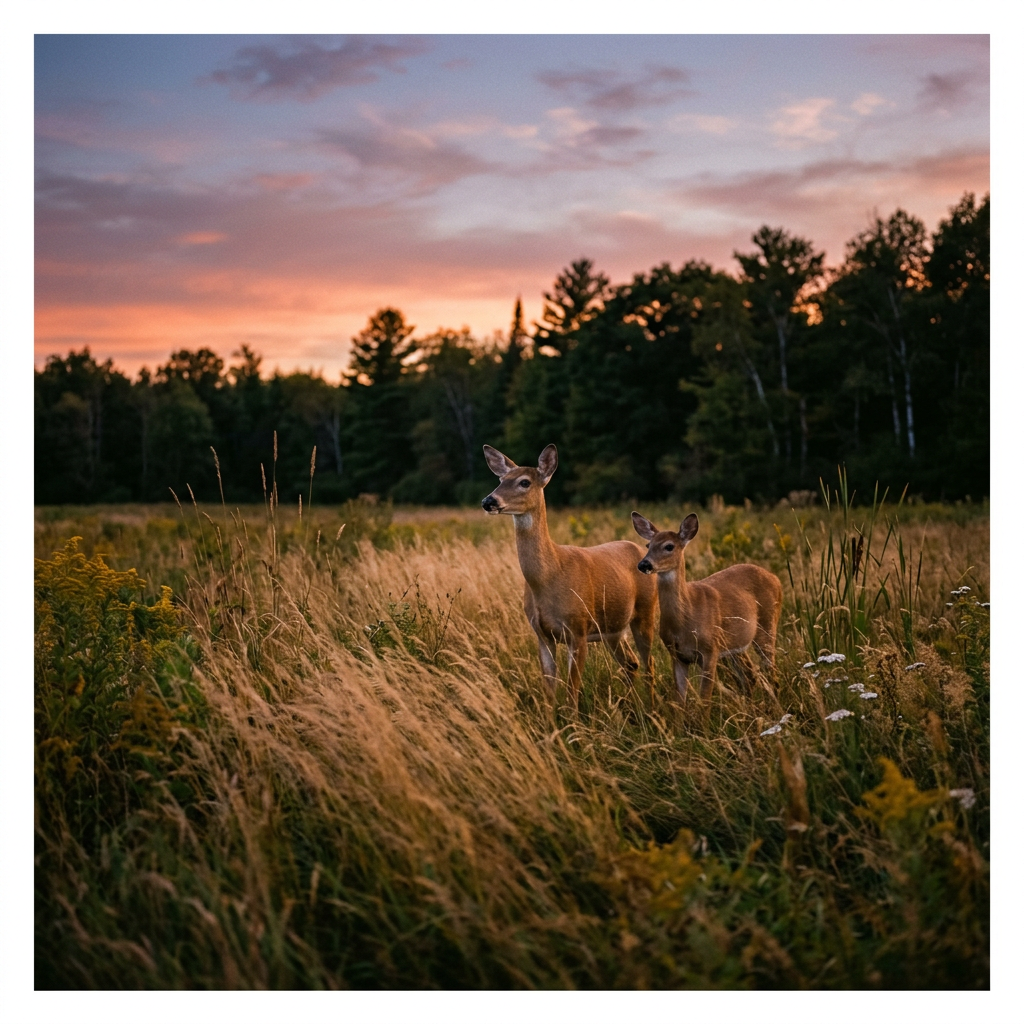
There is a certain hour in the evening when the field becomes more itself.
It is not dramatic at first. The light simply lowers. The edges of things soften. The gold begins to thin into gray-green, and the air changes in a way the body notices before the mind does. Birds quiet one by one. The taller grasses stop shining and start whispering. What looked open at sunset begins to feel hidden, even though nothing has moved.
This is one of the hours I trust most.
Perhaps because dusk asks less of us than daylight does. Daylight wants activity, naming, attention, movement. It exposes. It defines. But dusk lets things return to presence without forcing them to explain themselves. It gives the field back its depth. It lets shadow gather where too much clarity once sat. It reminds me that not everything beautiful arrives through brightness.
When I stand outside at that hour, I often feel that the land is speaking in a language older than words.
Not literally. I do not mean fantasy or performance. I mean that the body begins to register small truths differently. A breeze arriving across the grass no longer feels like background. The first coolness along the skin means something. The hush that settles over a stretch of open ground is no longer emptiness. It becomes full. Full of waiting. Full of transition. Full of all the life that continues whether I understand it or not.
Dusk has a way of undoing human arrogance.
In full daylight, it is easy to think the world is here for our seeing. We move through it naming, measuring, planning, filling. But at dusk, the field seems to withdraw slightly from that arrangement. It becomes less available to the busy mind. It no longer offers itself as scenery. It becomes its own presence again, and in that change, I am reminded that the earth does not exist to be fully grasped.
I love that.
I love that there are still hours when the world resists being turned into content, utility, or explanation. I love that the land can still become mysterious without becoming unreal. Dusk does not make the field less true. It makes it truer to itself.
Maybe that is why so many animals feel closer at that time, even when they are nowhere in sight.
You begin to sense them differently. A path through the grass suddenly looks used. A still line near the trees feels inhabited. The darkening edge of the world no longer seems empty, but shared. You remember, almost with relief, that human beings are not the only ones moving through the evening.
That feeling matters to me.
It softens the loneliness that modern life creates. The kind of loneliness that comes from too much enclosure, too much artificial light, too much time spent forgetting that we live among other presences. At dusk, the field restores that awareness quietly. It does not preach. It does not perform wonder for us. It simply keeps becoming what it has always been, and if we are still enough, we notice.
I think many people are afraid of dimness now.
We flood every space with light. We resist the coming of night as if darkness were only absence. But dusk has never felt empty to me. It feels layered. Tender. Honest. It feels like a threshold where the earth slips out of the sharp outlines we prefer and returns to a deeper kind of life.
Sometimes I wonder whether part of our disconnection from nature comes from refusing these thresholds.
We want everything visible, immediate, named, and controlled. But the living world keeps much of itself in transitions. Dawn. Rainfall. Tidal shift. Nesting season. First frost. The pause before full dark. These are not empty intervals. They are where so much of reality reveals its texture.
At dusk, the field speaks first.
Not in sentences. Not in symbols arranged for me. It speaks through change in temperature, in silence, in shadow, in the subtle rearranging of attention. It speaks by reminding me that the world is more alive than the modern mind knows what to do with.
And perhaps that is enough.
Perhaps not every answer has to arrive as an answer.
Perhaps sometimes it is enough to stand still while the last light leaves the grass, and to feel, if only for a moment, that the earth is still saying something older than language, and that some lost part of us still understands how to listen.
Gather by the fire
Leave a thoughtful note, reflection, or reply below.